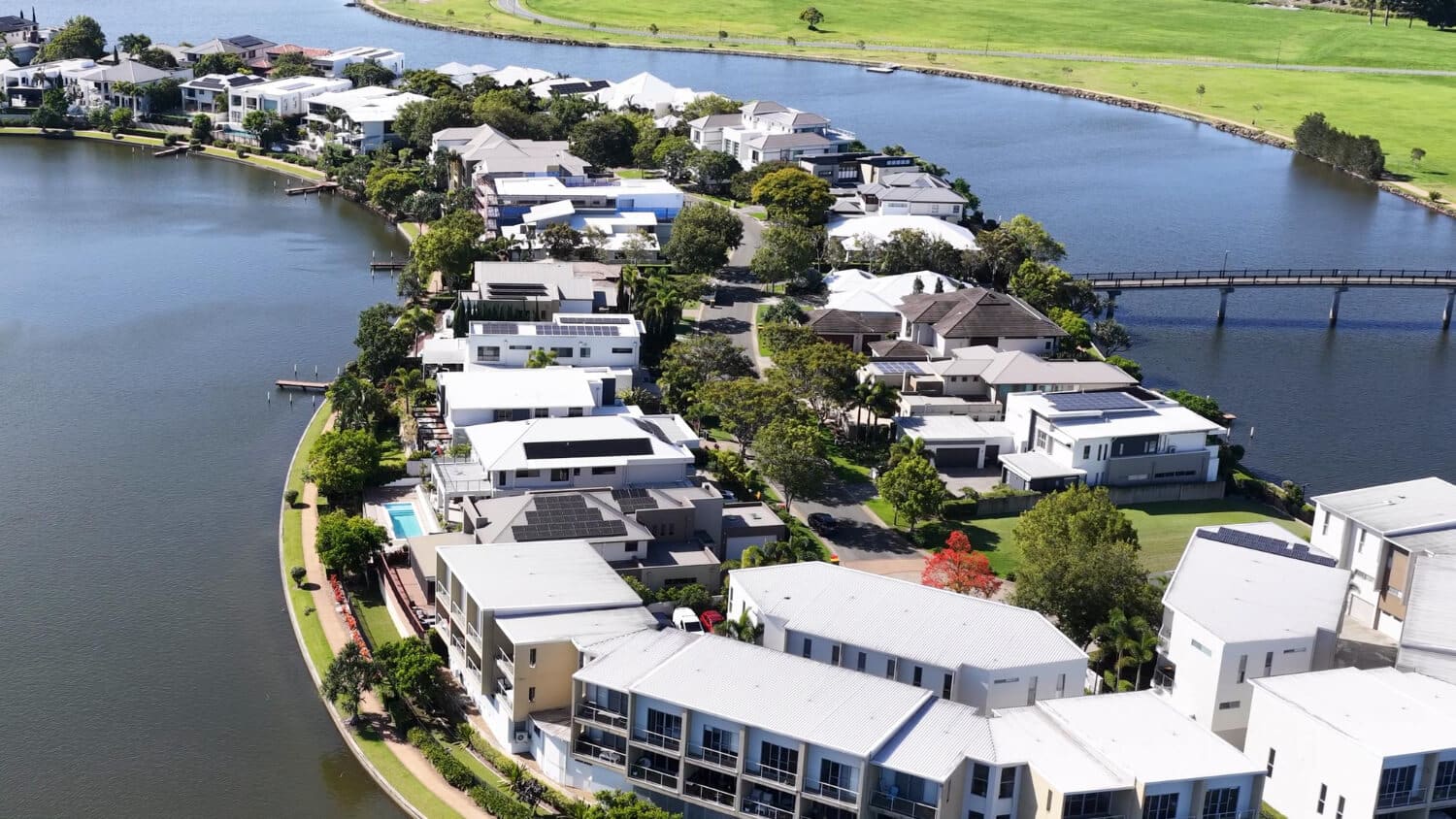
Quick answer: Sustainability features may influence Australian property markets through tenant demand, lower running costs and evolving regulation. In 2025, houses advertised with sustainable features sold for 14.5% ($118,000) more than non-sustainable homes, according to Domain. But sustainability is one factor among many. Location fundamentals still drive performance.
Amateur investors chase trends. Professional investors analyse mechanisms.
Sustainability has moved from the fringe of property conversations to the centre. Energy efficiency now appears in listing descriptions, government policy and tenant decision-making. You must understand how this shift works—not because it guarantees returns, but because it shapes demand.
This post breaks down what sustainable housing means, how it may influence investment markets, and where it fits within disciplined investment analysis. You will learn what the data shows, what it does not, and why long-term fundamentals still decide outcomes.
Why Is Sustainability Becoming a Bigger Consideration in Property Investment?
Sustainability is now a market signal. It used to sit at the edges of property discussion—a feature for the environmentally minded. That is no longer the case.
Investors increasingly monitor long-term housing trends and tenant expectations. Energy efficiency, running costs and thermal performance now factor into how buyers and renters compare properties. According to Domain’s Sustainability in Property Report 2025, 52.2% of houses and 39.1% of units sold across Australia in 2024 were advertised with sustainability keywords. Supply is rising. So is buyer awareness.
Government policy adds further weight. Building standards, energy-efficiency frameworks and infrastructure planning continue to evolve across every state and territory. These shifts may influence future market dynamics in ways that disciplined investors track closely.
You must treat sustainability as data, not sentiment. The professional investor does not assume green features create value. The professional investor examines how those features affect demand, costs and regulatory exposure—then weighs that evidence against every other fundamental.
What Is Sustainable Housing?
Sustainable housing describes properties designed to use resources efficiently. The definition is broad, and that breadth matters.
Sustainable housing may include energy-efficient design, environmentally conscious materials and resource-efficient features such as solar systems, water-saving infrastructure and high-performance insulation. A Passive House with near-zero energy bills sits at one end. A standard home with rooftop solar sits at the other. Both carry sustainability credentials, but they perform very differently.
Sustainability considerations vary significantly between developments and property types. A new greenfield build often integrates efficiency from the ground up. An established home may require costly retrofitting to achieve the same result. RMIT sustainable housing expert Trivess Moore notes that homes with core sustainability features often rank higher in overall quality—part of why they command higher prices.
Investors assess sustainability alongside broader fundamentals. You do not buy a property because it is green. You assess whether its sustainability profile contributes to tenant appeal, lower operating costs and long-term resilience—then you measure that against location, supply and demand.
How May Sustainability Influence Property Investment Markets?
Sustainability influences markets through measurable mechanisms. It does not create value by itself. It shifts demand, costs and risk—and those shifts can move prices.
How Do Energy Efficiency and Running Costs Affect Property Appeal?
Lower running costs change behaviour. Efficient buildings need less heating, cooling and grid energy. That reduces ongoing expenses for occupants.
Domain chief of research and economics Dr Nicola Powell identified rising cost of living as a key driver of demand for homes with lower energy bills. When utility costs climb, efficiency becomes a financial calculation, not a lifestyle preference. Properties that reduce operating expenses may attract stronger interest from cost-conscious tenants and buyers.
Why Does Tenant Demand Shift Toward Sustainable Properties?
Tenant preferences are changing. Some renters increasingly consider sustainability and utility efficiency when comparing rental options.
Research cited by RMIT indicates sustainability is moving from a nice-to-have to a normalised expectation. A property with lower energy bills offers a tangible advantage to a tenant comparing two similar homes. That advantage can contribute to tenant appeal and reduced vacancy exposure—both factors that professional investors track.
How Are Government Policy and Regulatory Trends Evolving?
Regulation is tightening. Building standards and sustainability frameworks continue to evolve across Australia.
The ACT already requires sellers and landlords to display an energy-efficiency rating. NatHERS, the national rating scheme, now assesses roughly 90% of new home designs, according to CSIRO. The market is edging toward broader disclosure of thermal performance. You must factor regulatory direction into long-term positioning, because today’s voluntary feature can become tomorrow’s mandatory standard.
How Does Sustainability Affect Long-Term Asset Positioning?
Future-proofing is a discipline. Investors assess how properties align with future infrastructure and environmental trends.
A property exposed to rising regulatory requirements or escalating energy costs may face pressure over time. A property positioned ahead of those trends may prove more resilient. You analyse this exposure now, not when the regulation arrives.
Why Do ESG Trends Matter to Property Investment?
ESG is reshaping institutional capital. Environmental, social and governance considerations have become a growing factor in broader property markets.
Large investors increasingly assess sustainability within acquisition and asset-management strategy. This institutional demand may influence the wider market over time, particularly for assets that meet evolving environmental benchmarks.
Which Sustainable Features Are Commonly Discussed in Property Markets?
Certain features dominate the conversation. You should know them, and you should know their limits.
Commonly discussed features include:
- Solar systems—rooftop panels that reduce grid reliance and energy bills.
- Energy-efficient appliances—fixtures that lower ongoing consumption.
- Water-saving infrastructure—tanks, efficient fittings and greywater systems.
- Thermal performance and insulation—wall, ceiling and underfloor insulation that stabilises indoor temperature.
- Sustainable building materials—lower-impact materials used in construction.
These features may contribute to appeal and reduced running costs. They do not guarantee higher returns. A solar system can be added for under $10,000, while premium double glazing may cost $50,000 to $100,000, according to RMIT analysis. The cost-to-benefit ratio varies enormously. You must evaluate each feature on its own merits, not assume that any single upgrade lifts value.
Why Is Sustainability Only One Part of Investment Analysis?
Sustainability is a factor, not a foundation. Treat it as the whole picture and you will misallocate capital.
Location fundamentals still dictate performance. Population growth, infrastructure investment and rental demand remain the structural forces that drive capital growth. A sustainable home in a weak location underperforms a standard home in a strong one. The data does not change this.
You must assess sustainability alongside broader market conditions and asset quality. Domain’s Dr Powell acknowledged that many sustainable homes are newer and located in outer-suburban greenfield areas—factors that independently affect price. Separating the sustainability effect from the location effect requires discipline. Amateur investors conflate the two. Professional investors isolate the variables.
How Are ESG Trends Influencing Institutional Property Investment?
Institutional capital follows ESG frameworks. Large-scale investors increasingly assess environmental and governance considerations across their portfolios.
Sustainability reporting and ESG frameworks are becoming standard practice in institutional strategy. Funds now scrutinise the environmental performance of assets, the regulatory exposure they carry and their long-term resilience. This is not ideology. It is risk management.
Long-term asset resilience sits at the centre of this thinking. Institutions analyse how an asset will perform as regulation tightens and energy costs shift over decades. As this capital grows, it may influence pricing and demand in segments that meet environmental benchmarks. You should understand this trend, because institutional behaviour often signals where broader markets move next.
What Are the Common Misunderstandings About Sustainable Property Investment?
Misconceptions cost money. Correct them before you deploy capital.
Sustainable features do not automatically guarantee capital growth. The Domain data shows a premium for sustainable listings, but it also reflects newer builds, better locations and higher overall quality—not sustainability alone.
Not all sustainability upgrades influence markets equally. A rooftop solar system and a full Passive House retrofit carry vastly different costs and returns. Market demand also varies significantly between regions and demographics. Solar take-up concentrates in outer-suburban areas, while inner-city homes often face heritage and overshadowing constraints. You must analyse the specific market, not apply a blanket assumption.
What Is the Role of Off-Market Opportunities in Future-Focused Markets?
Retail buyers see only what the portals show them. That inventory is fully priced and heavily contested.
Investors often seek assets aligned with long-term demographic and infrastructure trends—including properties positioned for future sustainability and regulatory shifts. Off-market investment properties may support strategic acquisition planning by reducing competition and creating room for data-driven negotiation.
Competitive markets reduce access to investment-grade opportunities. Sophisticated investors bypass the public system to secure assets before they reach the open market. You gain an advantage when you act outside the contested channel.
Why Do Long-Term Market Fundamentals Still Matter Most?
Fundamentals decide outcomes. Sustainability influences demand at the margin. The core drivers of capital growth remain unchanged.
You must evaluate these forces:
- Infrastructure investment—transport, services and amenity that pull tenants and buyers into an area.
- Population growth—rising demand that pressures fixed housing supply.
- Rental demand—the depth of the tenant pool supporting your income.
- Supply constraints—the structural scarcity that forces values upward.
- Employment hubs—job concentration that anchors long-term occupancy.
Sustainable housing trends sit within this framework, not above it. A property must satisfy the fundamentals first. Sustainability then refines the analysis. Reverse that order and you are speculating.
What Is the Role of Buyers Agents in Research-Driven Investment Strategy?
A buyers agent operates on data, not emotion. The function is research, analysis and disciplined execution.
A property investment strategy built on rigorous market analysis identifies where structural demand will outpace supply. It assesses sustainability exposure alongside location, infrastructure and regulatory trends. An investment property buyers agent sources off-market opportunities, applies objective analysis and supports strategic acquisition aligned with long-term goals.
You acquire on evidence. The buyers agent supplies the evidence and executes the strategy. That is the discipline that separates contested retail buying from research-driven investment.
Frequently Asked Questions
What is sustainable housing in Australia?
Sustainable housing describes properties designed to use resources efficiently, often through energy-efficient design, solar systems, water-saving infrastructure and high-performance insulation. Definitions vary significantly between property types and developments.
Can sustainability features influence tenant demand?
Yes. Some tenants increasingly consider energy efficiency and utility costs when comparing rentals. Lower running costs can contribute to tenant appeal, particularly as cost-of-living pressures rise.
Do energy-efficient properties always increase in value?
No. Domain data shows a price premium for sustainable listings, but this reflects factors such as newer builds, location and overall quality—not sustainability alone. No feature guarantees capital growth.
Why are ESG trends becoming more important in property markets?
Large institutional investors increasingly apply environmental, social and governance frameworks to manage long-term risk and asset resilience. This growing demand may influence broader market dynamics over time.
What factors should investors assess besides sustainability?
You must assess location fundamentals first: infrastructure investment, population growth, rental demand, supply constraints and employment hubs. Sustainability is one factor within this broader analysis.
How can buyers agents support research-driven investment decisions?
Buyers agents provide market analysis, source off-market opportunities and support strategic acquisition aligned with long-term investment goals—removing emotion and grounding decisions in data.
Ready to build a strategy on data rather than sentiment? Contact House Finder to discuss research-driven investment property opportunities.